Your own energy app, for your customers
A whole-home energy app for the people you serve — your brand, your features — powered by Joulely’s engine and its smart-meter connection. It shows each household where their money goes, and which of your tariffs fits how they actually use energy. A pilot in weeks. We never sell data.
What it costs, at a glance
Per customer, per month. The one-off integration is the only figure that depends on you — what sits behind these.
| What | Rate | What that covers |
|---|---|---|
| Our branding | 5p | per customer per month. The standard Joulely app under our name: hosting, the data pipeline, the modelling, tariff matching and updates. |
| Your branding | 10p | per customer per month. The same engine and features, wearing your name, colours and voice. |
| Anything bespoke | quoted | Your offers in the flow, time-of-use and flexibility, heat-pump and solar modelling, deeper integration — per customer per month on top, feature by feature. |
| AI support in-app | quoted | Optional. First-line answers from that household’s own usage, handing anything it can’t settle to your team. |
| One-off integration | scoped | Depends on your set-up. Our developers cost roughly £1,000 a day; we scope it with your tech lead and quote before you commit. |
| Monthly minimum | £1,000 | a month. You pay the greater of this or your actual usage — never both. The engineering costs the same at twenty thousand customers or two hundred thousand. Scale pricing for larger bases. |
| Bill-reading API | see /developers | Our second product, sold separately: post a bill photo, get the audited numbers back. Prices, docs and a sandbox → |
50,000 customers on your own branding: £5,000 a month. 5,000 customers: £1,000 a month, because the minimum is higher than the usage. Billed monthly, in arrears — one invoice after the month it covers, for the greater of £1,000 or your actual usage. Never both, no advance payment, no allowance to track and no part-months.
At 100,000 customers that is £5,000 a month, or £10,000 on your own brand — against £400,000 to £600,000 a year for an in-house app team, and a year and a half before it ships.
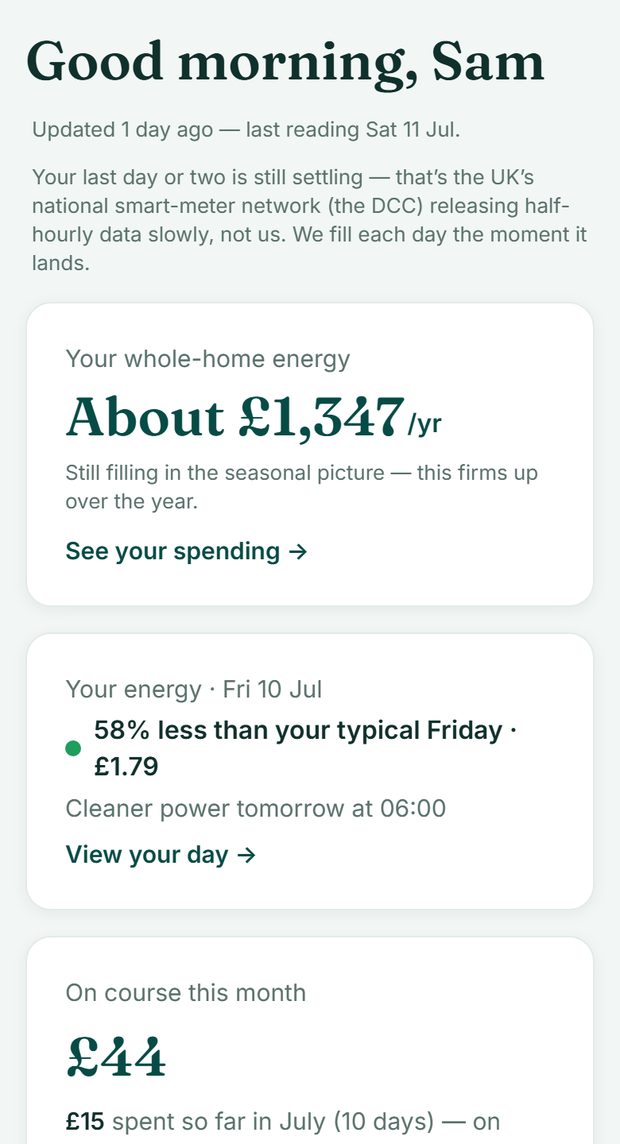
See it in action
Not mock-ups — the real product, running on one home’s own meter readings.
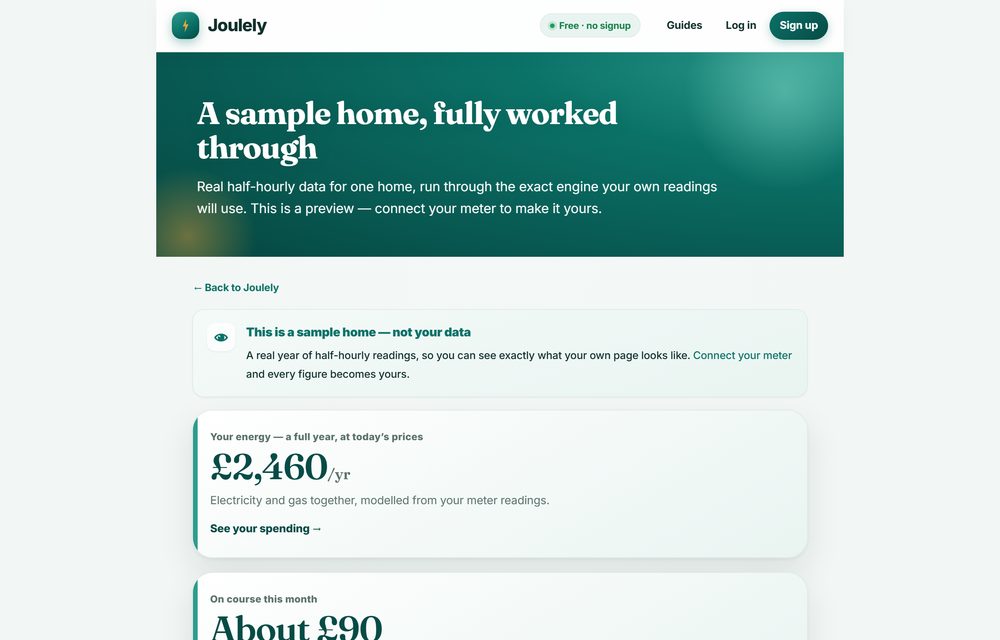
On the web
A full year of a home’s energy, month by month, modelled from its own half-hourly readings.
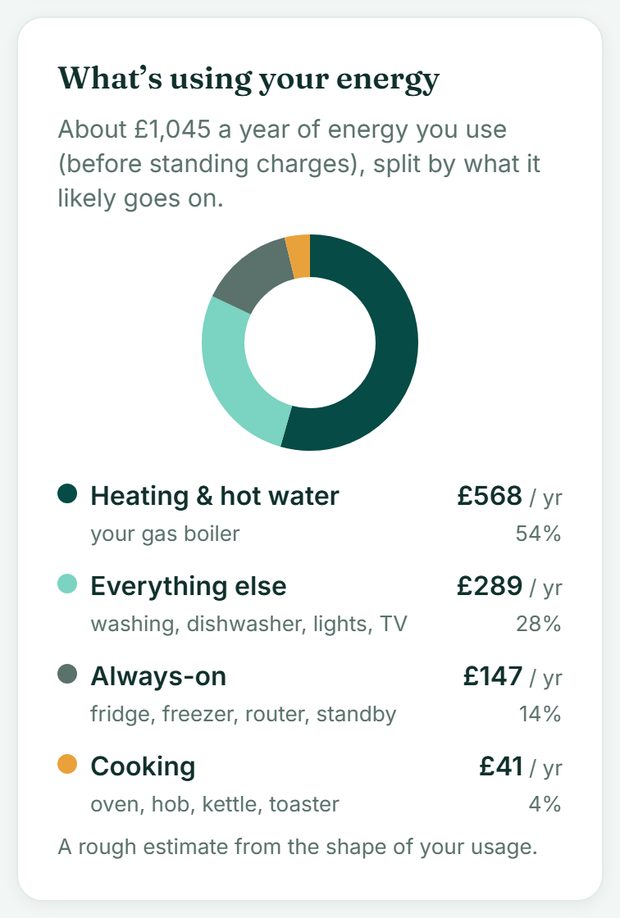
In the app
Where the money goes — heating, everyday use, always-on, cooking — estimated from the shape of that home’s usage.
Take a look at a white-label, on an invented brand
We built the whole thing on a made-up energy company, so you can see what yours would look like: their bill, their account, your promotions, and a recommendation onto a better-fitting tariff from your own book. It sits behind a password — ask below and we’ll send it over, usually the same day.
What your customers get
- Whole-home insight from their meter. Gas, electricity, solar — the real picture from a read-only smart-meter connection, not a typical-home guess.
- Where their money goes. Heating, everyday use, always-on, cooking — so their bills finally make sense.
- “We noticed” signals that help. A bill creeping up, a home heading for winter debt — so no one gets a nasty surprise.
What you control
- Your promotions, front and centre. Your own offers and messages inside the app, to customers you already have — a channel you own, not a marketplace.
- Your new-customer offers. It’s your app promoting you, no one else.
- Bespoke features, built around you. Features tailored to your business: you decide what’s in, and we build it in — quoted per customer per month on top of the 5p or 10p, feature by feature, so you see what each one costs before you choose it.
- Your branding throughout. Your name, your colours, your voice, top to bottom. To your customers it is your app.
Your tariffs, matched to how each home really uses energy
This is the part most apps can’t do — and the reason to talk to us.
- The only tariffs in your app are yours. We are not a switching service and we never will be inside your app. We don’t show your customers other companies’ deals and we never tell them to leave you.
- We tell them which of yours is right for them. Fixed or variable, Economy 7, time-of-use, an EV tariff — the right answer depends on the shape of a household’s half-hourly usage, not on their annual total. That shape is exactly what we hold, so we can say “on your usage, our fixed tariff would have cost you £X less last year” and show the working.
- A household on the wrong tariff is a churn risk. Moving them onto the right one of yours is cheaper than losing them, and a better conversation than a renewal letter.
- We can show you this before you commit anything. We already track real, regional tariff data across all fourteen GB regions, refreshed daily for most suppliers — it’s public, on our tariff data page. So we can model your published tariffs against a real home’s year of half-hourly readings in the first conversation, before you give us access to anything.
Who it’s for
Energy suppliers, housing associations, brokers, employers and membership organisations — anyone with people to look after and their own offers to put in front of them.
How it works
- 1. Talk to us. Tell us who you serve. We’ll model your published tariffs against a real home’s year of usage before you commit to anything.
- 2. Feasibility, with your dev team. A short piece of work with whoever owns your data, to establish how we’d read it and what that costs. This is where a no comes out, if it’s going to — in a fortnight rather than six months in.
- 3. We set it up and connect to your systems. Our name at 5p, yours at 10p; bespoke features and your own offers quoted on top. A supplier already holds its customers’ half-hourly data — you bill on it — so we read it from you, and there is nothing for your customers to set up and no third-party data fees.
- 4. Your customers use it. Their real whole-home picture appears, and your promotions sit right there in your app.
What sits behind those rates
The rates and the minimum are in the table near the top of this page, published, because nobody else in this market will tell you until you are three meetings in. Four things sit behind them.
- The one-off integration is the only real unknown. A supplier who can hand us a clean daily export is a different job from one where we’re working round a legacy billing system, so there is no standard number. Our developers cost roughly £1,000 a day, and the more your own team can help us get at the data, the faster and cheaper it is. We scope it with your tech lead and quote before you commit — and a pilot is a fraction of a full integration.
- Your call centre keeps the customer — and we plug into it. Your team answers your customers; we hook into your helpdesk so an agent can see what that household is looking at, and we take anything genuinely technical behind them. That is what keeps the rate at 10p rather than several times it.
- AI support instead, if you’d prefer. An in-app first line that can see that household’s own usage, tariff and readings, so it answers “why is my bill higher this month” with their numbers — and hands anything it can’t settle to your team with the context attached.
- Phased, not all at once. A pilot cohort first, then a region, then everyone. You prove it internally before you commit your whole base, and nobody — including us — gets surprised at scale.
If the numbers don’t work for you they don’t work, and we’d both rather know now.
Or sponsor Joulely for the people you serve
White-labelling isn’t the only way in. A household pays from £1.60 a month while its meter is connected (£1.60 for one meter, £2.70 for gas and electricity) — that covers the meter data and the servers, and nothing else. A sponsor covers it for a group of people they care about, so residents, staff, members or customers pay nothing. A council, an employer, a charity, a housing association, a community group: we don’t restrict who can sponsor.
- A plain thank-you in the app, not an ad. A mention that you made this possible. People remember who helped them understand their bills.
- A place in our monthly newsletter. Your offers, to the people you sponsor — provided they genuinely help. Never spam.
Let’s build yours
White-label, sponsor, or both. Sponsoring means you cover what a household pays, from £1.60 a month while its meter is connected (£1.60 for one meter, £2.70 for gas and electricity), so it costs your people nothing — that buys the meter data for one home, which is the whole difference from the 10p above, where the data is already yours. Tell us a little and we’ll come back to you.
Prefer email? Write to business@joulely.co.uk and we’ll pick it up just the same.
For your security, legal and procurement teams: the trust pack collects our security statement, sub-processor list, service levels and data processing agreement, plus the company we contract as. Send them the link before we speak — it answers most of a first questionnaire.
Your home bills, checked on your own numbers — £0 commission on any switch.
Check your home · Check your energy bill (free) · Council tax check · Guides · Help & FAQ
About · For business · Who we support · Privacy & your data · Terms · Tariff data & supplier corrections